


When Justice Becomes a Spectacle

There are moments when I look at the direction of our country and wonder what, exactly, we are teaching our children. Not simply what we are teaching them about politics or patriotism, but what we are teaching them about God?
Specifically about justice, mercy, and the sanctity of human life. And about what happens when we begin using the name of Jesus Christ to justify things that seem increasingly difficult to reconcile with the Jesus Christ we encounter in Scripture.
The announcement that the United States intends to livestream the execution of a convicted mass murderer by firing squad has left me deeply unsettled. And as I have listened to the arguments in favor of it, particularly those coming from people who identify strongly with Christianity and the pro-life movement, I have found myself returning again and again to a question:
How can we claim to defend the sanctity of human life while celebrating the deliberate taking of it?
I know the arguments. I understand the desire for justice. I understand the outrage at horrific violence. But I am Catholic. I am a Bible-believing, God-fearing Christian. And increasingly, I am grateful for a Church that challenges me to examine not only what I believe, but whether those beliefs are consistent with the Gospel I profess.
First, the lives of the victims are incredibly valuable.
On November 5, 2009, Nidal Malik Hasan murdered thirteen people and wounded thirty-two others at Fort Hood, Texas. Thirteen lives were stolen. There are thirteen families who have carried the consequences of that violence for nearly seventeen years. Futures were interrupted. Children were affected. There is grief that no sentence, no punishment, and no public spectacle can undo. Hasan was convicted and sentenced to death.
The gravity of his crimes is not in question.
I want to be very clear about something: opposing his execution does not mean excusing his actions. It does not mean minimizing the suffering of his victims or suggesting that justice is unnecessary. Justice is necessary. Scripture tells us so.
Romans 13 speaks of legitimate governing authority and its responsibility to restrain evil. The Catholic Church likewise recognizes the responsibility of the state to protect its citizens and impose penalties proportionate to serious crimes. But justice and vengeance are not interchangeable.
The most important question is not whether this man deserves punishment. It is whether the state must kill him to accomplish justice. Those are two very different questions.
What does the Bible say about the death penalty?
This is where I believe we need to be intellectually and theologically honest. Yes, there are passages in Scripture that have historically been used to defend capital punishment.
Genesis 9:6 says:
“Anyone who sheds the blood of a human being, by a human being shall that one’s blood be shed; for in the image of God have human beings been made.”
The Mosaic Law also prescribed capital punishment for certain offenses.
And Romans 13:4 describes governing authority as one that does not bear the sword without purpose.
These passages cannot be ignored because they complicate our argument. But neither can they be separated from the fullness of divine revelation.
Catholics do not approach Scripture as a collection of isolated verses from which we select whichever passage most comfortably supports our existing position. That’s “cherry picking” and it gets on my nerves.
We read Scripture as a whole, in the light of Christ, within the living Tradition of the Church. And when we turn to Christ, we encounter something extraordinary.
In John 8, a woman accused of adultery is brought before Jesus. Her accusers appeal to the Law of Moses, which prescribed death by stoning. Jesus does not declare her sin insignificant. He does not suggest that morality is relative.
Instead, He challenges the crowd:
“Let the one among you who is without sin be the first to throw a stone at her.” — John 8:7
One by one, the accusers leave. And Jesus tells her to go and sin no more.
This passage is not a ruling on modern criminal sentencing. But it reveals something essential about the heart of Christ: He does not confuse mercy with moral indifference.
He recognizes sin without surrendering the sinner to the crowd’s desire for punishment.
And then there is the Cross. Our entire Christian faith rests upon the execution of an innocent man by the governing authorities of His day. Jesus knows what it means for the machinery of the state to put a human being to death.
And what does He say from that Cross?
“Father, forgive them, they know not what they do.” — Luke 23:34
Not because the injustice was small, but because the mercy of God is greater.
Even the repentant criminal crucified beside Him receives a promise of paradise (Luke 23:39–43).
A man at the very end of his life is not beyond redemption. How, then, can Christians so easily celebrate the extinguishing of another person’s opportunity for repentance?
What the Catholic Church actually teaches:
For those unfamiliar with Catholic teaching, the Church’s position on capital punishment may come as a surprise.
Historically, Catholic theology acknowledged the authority of the state to impose the death penalty under certain circumstances. That history is relevant here, and it would be inaccurate to pretend the Church has always expressed its position in precisely the same way.
But Catholic teaching has developed in its understanding of human dignity, punishment, and the means available to protect society. St. John Paul II urged a movement away from capital punishment, particularly when nonlethal means could protect the public.
In 2018, Pope Francis approved a revision to paragraph 2267 of the Catechism of the Catholic Church.
It now teaches:
“The death penalty is inadmissible because it is an attack on the inviolability and dignity of the person.”
And the Church works for its abolition worldwide. Why?
A person’s dignity does not disappear because that person has committed a terrible crime.
That dignity is not something we award to the morally deserving. It is something God has already bestowed.
Genesis 1:27 tells us that human beings are created in the image of God.
Not perfect and law-abiding human beings. Human beings.
The Church does not teach that the guilty should escape punishment. Life imprisonment and other secure forms of detention can protect society while holding offenders accountable. When society can be protected without deliberately ending a human life, the Church teaches that execution is not an acceptable response.
Can we really call ourselves pro-life?
This is the most uncomfortable part of the conversation and what has troubled me deeply. I believe in the sanctity of unborn life. I believe the most vulnerable among us deserve protection, particularly when they have no voice with which to advocate for themselves.
But the Catholic understanding of being pro-life does not begin at conception and end at birth, nor does it end when someone becomes guilty of a crime.
In April of this year, Pope Leo XIV addressed those commemorating the abolition of the death penalty in Illinois. He reaffirmed that human life is sacred from conception until natural death and that even those convicted of very serious crimes retain their human dignity.
From conception until natural death.
The unborn child and the convicted murderer are not morally equivalent in their actions or innocence. They are, however, equally human. Their humanity is not ours to revoke.
This does not mean every threat to life presents the same moral questions. Abortion, euthanasia, self-defense, warfare, and capital punishment involve different circumstances and responsibilities. I get it, apples and oranges and all that. But the foundational conviction remains the same: human dignity is inherent, not conditional.
If I defend the life of an unborn child because that child bears the image of God, I cannot simply disregard that same image when it belongs to someone whose actions I find reprehensible.
In Romans 12:17, St. Paul instructs Christians not to repay evil with evil. There is a difference between restraining evil and reproducing it. I think this is a what makes my eyes widen with each article I read. There is a difference between protecting the innocent and making death an instrument of public satisfaction.
As troubling as the death penalty itself is, the announcement that this execution is intended to be livestreamed introduces another layer of moral concern. We are not simply talking about a state carrying out a sentence. We are talking about inviting the world to watch a human being die: to make an execution accessible through a screen.
And I cannot help asking: What kind of society does that make us? Public executions have not disappeared entirely from the modern world.
Iran, Taliban-controlled Afghanistan, and North Korea
Is this really the company in which we want to find ourselves?
What are our children learning? What are we desensitizing ourselves to? That violence becomes righteous when the government authorizes it? That human dignity can be forfeited? That the appropriate response to a horrific killing is to gather around yet another?
I think of the children who will grow up in this cultural atmosphere. I think of the young people learning to associate strength with cruelty, justice with retaliation, and patriotism with unquestioning approval of state power.
And I wonder whether we are teaching them to love justice or simply to enjoy seeing someone punished. Those are not the same thing.
The Pope and the bishops have spoken; don’t roll your eyes. There’s actually really good reason that we have them. I’m grateful.
On October 10, World Day Against the Death Penalty, Pope Leo XIV reaffirmed the Catholic Church’s teaching that capital punishment is inadmissible. His statement followed strong criticism of the planned public execution from Church leaders.
Cardinal Pietro Parolin, the Vatican Secretary of State, condemned the proposed spectacle, emphasizing that even a guilty person’s dignity must be respected.
Archbishop Paul Coakley, president of the United States Conference of Catholic Bishops, responded with shock and sorrow. He described the plan as:
“A barbaric promotion of a culture of death.”
He warned that publicly executing even someone responsible for grave harm would damage the moral fabric of our nation. These are not the words of people who are indifferent to murder. They are the words of shepherds who understand that a civilization is judged not only by how it protects the innocent, but also by how it treats the guilty. We would do well to listen.
Why do Catholics listen to the Pope and bishops?
One of the most significant changes in my journey from Protestantism to Catholicism has been my understanding of authority. For much of my Christian life, I was accustomed to interpreting Scripture through the lens of my own study, my pastors, and the theological traditions in which I had been formed.
I still love studying Scripture. I still believe Christians have a responsibility to read it carefully, prayerfully, and intelligently.
But becoming Catholic introduced me to something I had not fully appreciated before. The Church is not merely a collection of individual believers arriving at their own interpretations of Christianity. I’ve been there, and I’ve seen how Scripture can be twisted to fit a narrative. To justify sin.
Christ established a Church.
In Matthew 16:18–19, Jesus gives Peter the keys of the kingdom. In Luke 22:32, He charges Peter with strengthening his brothers. In John 21:15–17, He repeatedly instructs Peter to feed and tend His sheep.
The Catholic Church understands these passages, together with apostolic succession and the witness of the early Church, as foundational to the pastoral authority entrusted to Peter and the apostles and continued through the Pope and bishops.
The Second Vatican Council’s Lumen Gentium explains that bishops, in communion with the Pope, have a responsibility to teach and safeguard the faith.
This teaching authority is called the Magisterium.
It does not mean every opinion expressed by a bishop is infallible, or that Catholics must agree with every prudential judgment made by Church leaders. Nor does it mean that the Pope is above Scripture.
The Magisterium serves the Word of God. Its responsibility is to preserve, interpret, and faithfully transmit what has been entrusted to the Church. And when the Church teaches authoritatively on faith and morals, Catholics are called to receive that teaching with appropriate religious assent.
I do not look to the Pope because I believe he is a political strategist whose preferences should replace my own. I look to the Pope because I believe Christ did not leave His Church without shepherds.
And I have come to recognize that one of the greatest gifts of belonging to the Catholic Church is that its moral teaching is not supposed to bend according to whichever political party currently holds power.
Sometimes the Church challenges the left. Sometimes it challenges the right. Sometimes it challenges me.
When patriotism begins to sound like religion:
There is another part of this moment that troubles me. In September, Defense Secretary Pete Hegseth spoke at Texas A&M University as part of his Send Me Tour, invoking Isaiah 6:8.
In that passage, the prophet Isaiah responds to the call of God:
“Here I am … send me!” — Isaiah 6:8
Hegseth connected those words with the willingness of American service members to fight the nation’s enemies. Later, in an address to military personnel at Quantico, he spoke of the military putting on the full armor of God and described the struggle as spiritual as well as physical.
Now, I have enormous respect for those who serve in our military. Close family members are veterans. I will leave them with their privacy, but I am so proud of their sacrifice.
I believe military service can be an honorable vocation. Catholic teaching recognizes legitimate defense and the responsibility of governments to protect their people. And I do not believe Christians must leave their faith behind when they enter public service.
But I become deeply concerned when the language of divine calling is used to frame the military objectives of a nation. Isaiah was not being commissioned to advance the interests of a modern nation-state. He was being called to speak the word of God, including words that would confront the sins of his own people.
And when St. Paul describes the armor of God in Ephesians 6, he explicitly says that our struggle is not against flesh and blood. The passage is about spiritual resistance to evil, grounded in truth, righteousness, faith, salvation, and the Word of God.
It is not a blank check for the use of military force.
I worry about what happens when we take language intended to describe faithfulness to God and begin applying it too easily to the exercise of national power.
The United States is not the Kingdom of God.
And no political leader, military official, or political movement has the authority to claim that its actions are automatically God’s will. Christian nationalism concerns me precisely because it risks confusing devotion to Christ with loyalty to a nation, a political movement, or a particular vision of American identity.
It can transform faith from something that judges earthly power into something used to legitimize it.
I love my country. But I worship God. Those loyalties are not interchangeable.
What would Jesus have us do?
There is a scene in Luke 9 that I have been thinking about.
When a Samaritan village refuses to welcome Jesus, James and John ask whether they should call down fire from heaven to destroy it.
They believe they are defending their Lord. They are offended on His behalf. They are ready to answer rejection with destruction.
And Jesus rebukes them.
I wonder how often we, too, convince ourselves that our anger is righteous simply because we attach God’s name to it. How often do we confuse the desire to see evil defeated with the desire to see people destroyed?
I do not have an easy answer for the families who lost loved ones at Fort Hood. I cannot pretend to understand the depth of their suffering. And I would never presume to tell them how they should feel about the man responsible.
But the moral responsibilities of a government, and the obligations of Christians, cannot be determined solely by the intensity of our anger.
Jesus calls us to something more difficult. He calls us to love our enemies (Matthew 5:44). He calls us to mercy (Luke 6:36). He calls us to resist the temptation to repay evil with evil (Romans 12:17–21). And He reminds us that whatever we do to the least among us, we do to Him (Matthew 25:40).
Christian justice must remain accountable to Christian love.
I Will Not Stay in My Lane
I have always been an intensely empathetic person, sometimes to my own detriment. I feel things deeply. The suffering of people I have never met can sit heavily on my heart. Injustice troubles me. Cruelty unsettles me. And the ease with which we sometimes dismiss the humanity of others can leave me genuinely heartsick.
I know there are people who would prefer that I stay in my lane: speak about the things I know, the people I serve, and the causes everyone can comfortably agree are worthy of my attention.
But I cannot, and I will not, confine my concern for human dignity to the populations I happen to serve.
My work has taught me to recognize vulnerability, to advocate for those whose voices are overlooked, and to see the person before the diagnosis, the disability, or the circumstances of their life. My faith has taught me that this obligation extends far beyond the boundaries of my own life.
Human dignity is not a specialty area. It is a moral conviction. I refuse to believe that having a tender heart somehow disqualifies me from speaking about difficult things. Empathy is not an intellectual weakness. Compassion does not make someone incapable of understanding justice. And being deeply affected by suffering does not mean I am incapable of thinking critically about it.
In fact, I would argue that our world could use a little more willingness to be affected.
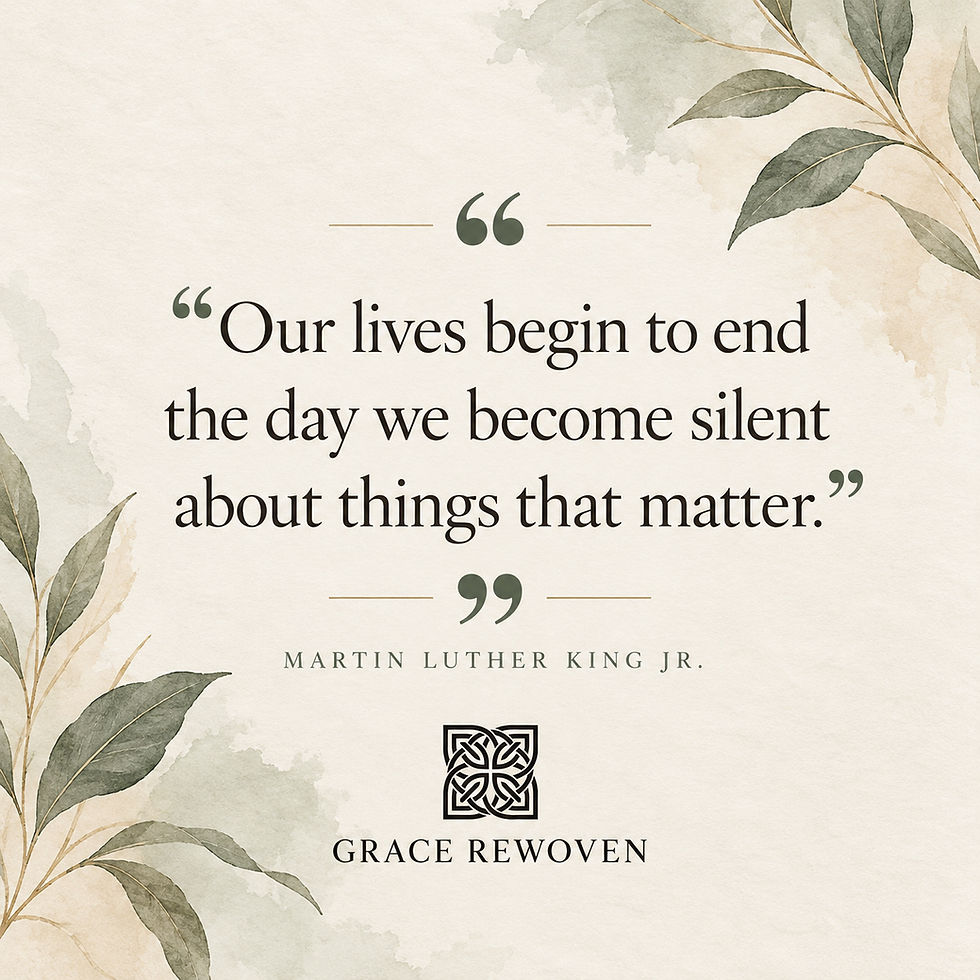
There is a difference between speaking because we believe ourselves superior and speaking because remaining silent would feel like a betrayal of what we profess to believe. I am not interested in being loud for the sake of being heard. I am interested in being faithful, even when faithfulness requires courage.
And if the Gospel has taught me anything, it is that love of neighbor was never intended to stop at the edge of what makes us comfortable.


Comments