


Holy Matrimony: When the Ordinary Became Sacramental
- Jaci Scott
- Mar 13
- 9 min read

Today marks one year since one of the most grace-filled days of my life.

On March 13, 2025, in the heart of Lent, my husband was baptized. In that same Mass, we were both confirmed in the Catholic Church, received our first Holy Communion, and in the midst of it all, had our marriage convalidated before God and the Church. We had the joy of celebrating a second wedding with friends and family in attendance. The readings that day were from Esther, Psalm 138, and Matthew 7:7–12, and looking back now, they feel as though they had been chosen with our story in mind. It was a day marked by holy precision, where the Lord seemed to gather every thread of our lives and weave it into something fuller, deeper, and unmistakably his.
That day felt like heaven bending down into the details.
Father Selva preached about green and new beginnings. What he did not know was that green had already become precious to us. My engagement ring is a blue-green emerald, and over time that color had quietly threaded itself through our story long before it was ever spoken from the altar. Even that small detail felt like a whisper from the Lord: I am here too. I am here in the symbols, in the memories, in the parts of your life you thought no one else could possibly know.

The readings, too, felt impossibly personal. The first reading came from Esther, where she turns to the Lord in anguish and prays from a place of vulnerability and dependence. That day, her prayer struck something deep in me. There was something in her hiddenness, in her desperate appeal to God, that mirrored a season of my own life during divorce; a season marked by pain, isolation, uncertainty, and the feeling of being enclosed by it all. Esther’s prayer is the prayer of someone who has run out of self-sufficiency. She asks the Lord for help because she knows he alone can save. On a day that marked so much healing and beginning again, that reading felt less like coincidence and more like mercy.
(I have a picture for this spot, taken in a moment of the Lord whispering in a tender way, “Remember this because it’s not always going to be this way.” But it is frought with tears, pain, and despair; I can’t bring myself to share. Just know that the stark contrast between that picture and the pictures of our wedding day(s) are the definition of God’s redemptive mercy.)
The psalm that day was Psalm 138: “On the day I called, you answered me.” Even now, that verse feels like the caption beneath the whole day. We did not find our way into the Church by accident. We did not steady ourselves by sheer willpower. The Lord answered us. Slowly, gently, patiently, he answered us. He answered through longing, through unrest, through questions, through people, through study, through suffering, through beauty, and finally through the sacraments themselves.

And then the Gospel: “Ask and it will be given to you; seek and you will find; knock and the door will be opened to you.” I cannot read those words now without thinking of the road that led us there. We were seeking long before we understood where that seeking would end. Maynard was searching for landing; a runway in his faith. I was coming out of years of Protestant ministry, deconstructing, healing, and trying to learn how to belong to the Lord again without the old pressure to perform. We were both healing from prior divorce. We were not rejecting God prior; we were trying to find our footing. And in his kindness, as if we were fumbling through a dark hallway, he did exactly what Christ promised in that Gospel: he opened the door. And the light shone forth.

The highlight of that day was seeing Maynard baptized.
Even now, I do not know how to fully explain what it is to watch someone you love become new before your eyes. The Catechism says that the sacraments are “efficacious signs of grace, instituted by Christ and entrusted to the Church, by which divine life is dispensed to us.” That means a sacrament is not merely symbolic. It is not a sentimental religious gesture. Christ truly acts through it. Grace is really given. Something real happens.
That is why what I witnessed in Maynard was not emotional excess or religious enthusiasm. It was real grace. While I was cleaning our reception space with a friend a few days before our Mass, she looked up from her broom and said, “He will be different. In a good way. He’s about to become a new person.” I was not prepared for how true those words would prove to be. But she was right.
He is different.

Not in a loud or theatrical way, but in the deep, steady, unmistakable way that belongs to God. There was a newness in him. A groundedness. A peace. A change that could not be explained away.
Father Mike often explains the sacraments as visible signs of invisible grace. That phrase has stayed with me because it captures exactly what I saw that day. Water was poured, words were spoken, oil was used, vows were blessed. Everything visible pointed to something invisible and real that God was doing beneath the surface, and the fruit of that grace did not remain at the altar.

It came home with us!
Then came the blessing and convalidation of our marriage.

That moment deserves its own space in my memory, because what happened there was not merely symbolic. It was not simply a sentimental acknowledgment of a love we already shared. Christ was truly present in that sacramental moment, blessing, strengthening, and completing what had begun in sincerity and love. Our convalidation was not the Church “recognizing” us in a purely ceremonial sense; it was God drawing our marriage into covenantal fullness and pouring out grace for us to live it.
And for one year now, that is the grace we have been blessed to live from. We have not just looked back on that day as a beautiful memory; we have partaken in its fruit. We have lived inside the blessing of a marriage strengthened by God’s presence, sustained by his grace, and anchored in something far deeper than our own effort. That is part of what has made the difference so tangible: this is not just a symbol we admire, but a sacramental reality we now live in.
Then came the Eucharist.

And there too, Christ gave himself not as metaphor, but as gift. After the blessing of our marriage, to then receive him in the Eucharist felt like the fullest possible seal on the day: his presence not hovering at a distance, but given, received, and dwelling within us. What had been blessed was now nourished. What had been consecrated to him was now united to him in the most intimate way the Church offers this side of heaven.
Our civil wedding mattered deeply. It was beautiful, and it was the beginning of a real love story. On the white sand beaches of Jamaica, with stormy skies parted and clear blue water behind us, the Lord was already being kind to us. He was already guiding us, already shaping something we could not yet see clearly. What we did not know when we married civilly was that we would become Catholic. We did not know that one day our marriage would be caught up into something deeper than a private promise. We did not know that the Lord would take what was already meaningful and bring it into sacramental covenant.
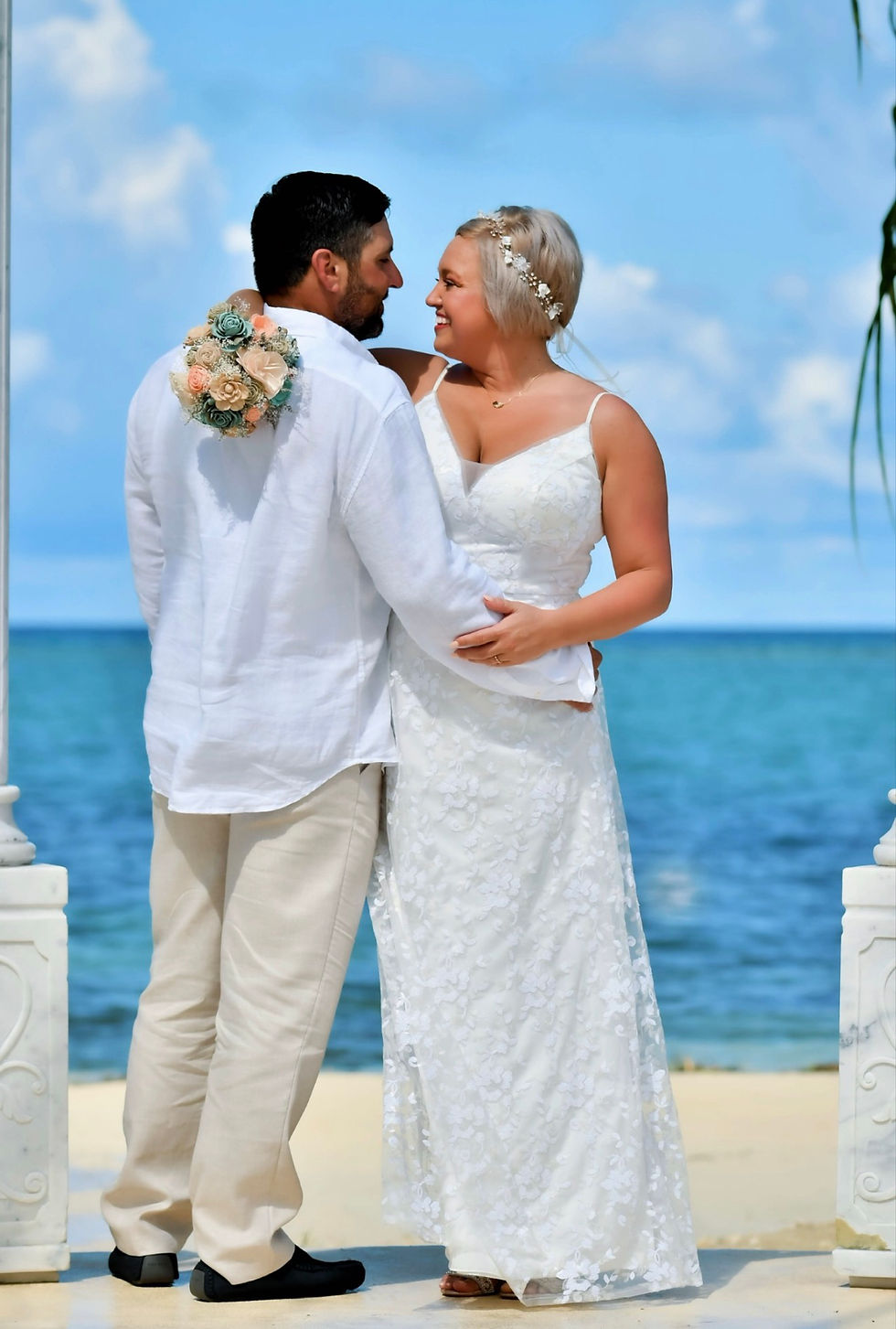
The convalidation did not erase what came before. It fulfilled it. It brought completion to something that had begun in sincerity and love, but had not yet been sealed in the way Christ intends Christian marriage to be lived. What I understand now is that God was never absent from our beginning. He was gently leading us toward its fullness.

The Catechism teaches that the grace proper to Matrimony is meant to perfect the couple’s love and strengthen their indissoluble unity, and that by this grace spouses help one another attain holiness in married life and in welcoming and educating their children. It also teaches that Matrimony signifies the union of Christ and the Church and gives spouses grace to love each other with the very love with which Christ has loved his Church.
That is no longer abstract theology to me.
I have now lived long enough on the other side of sacramental grace to say that it is not theoretical. It is something you can feel in the walls of a home.
The peace in our marriage is palpable.
There is a steadiness now, a tenderness, a closeness that comes from seeking the Lord together. There is greater trust because ours is no longer merely a private bond held together by affection and determination, but a covenant upheld by grace. There is a kind of rest between us that I do not think can be manufactured. And when unexpected turns come, as they always do, we know that God will deliver. Not always according to our own timing or preferences, but faithfully. Reliably. I do not worry the way I once did.

This is one of the quiet miracles of sacramental marriage: grace does not make a couple less human. It makes love more rooted, more enduring, more capable of peace. It sanctifies the ordinary. It gives strength not only for grand gestures, but for daily fidelity, softened words, patience in difficulty, forgiveness after hurt, and tenderness that does not evaporate when life becomes demanding.
This is why the Church speaks of marriage as an image of Christ and the Church. In Ephesians 5, St. Paul writes, “Husbands, love your wives, as Christ loved the church and gave himself up for her,” and then says that this mystery refers to Christ and the Church. Christian marriage is not merely companionship, though it includes that. It is not merely romance, though romance has its place. It is a covenant of self-gift. It is meant to mirror the love of Christ: faithful, fruitful, sacrificial, and unbreakable.
That parallel once sounded lofty to me. Now it feels intensely practical.
Christ does not love the Church only when she is radiant. He loves her into radiance.
Christ does not abandon the Church. He remains.
Christ does not revoke his covenant when the road grows bumpy or worn. He gives himself more fully.
That is the pattern sacramental marriage mirrors. Not perfectly, because we are human. But truly, because grace is real.
I have seen that grace in the peace of our home. I have seen it in the closeness between us. I have seen it in the stability that has settled over our marriage. I have seen it in Maynard’s transformation. I have seen it in my own change of heart and countenance, too.

My journey from Protestant ministry into the Catholic Church has been, among many things, a journey out of striving. I no longer live with the same spiritual unease or the same pressure to perform. I am at rest in the Lord. That rest has entered my marriage too. There is something profoundly healing about living inside a covenant that does not depend solely on our own strength, but is continually nourished by sacramental grace.

And that grace has not remained confined to the two of us. One of the fruits of this sacramental year has been a closer relationship with each other’s children. Our children.
Us.
We.
Grace spills outward. The Catechism’s teaching on Matrimony includes not only the sanctification of spouses but also grace for family life and for welcoming and educating children. That feels important to name because sacramental marriage is never only about the couple in isolation. It creates a home, a domestic church, a place where faithfulness can be seen and peace can be learned.
What the Lord has taught me through all of this is that sacraments are not decorative. They are not religious extras laid over an otherwise self-made life. They are encounters with Christ. They are the places where he gives what he signifies. They are where grace takes on a form we can touch, receive, and live from. What. A. Gift!
He has taught me that covenant is stronger than feeling.
He has taught me that peace is one of the clearest signs of his presence.
He has taught me that holiness often arrives quietly: in daily fidelity, in the choice to love again, in softened voices, in burdens shared, in trust that has deepened, in a home that feels steadier than it used to.
He has taught me that ordinary love, when surrendered to him, can become sacramental.
And perhaps most of all, he has taught me that he is in the details.

He was there in Esther’s cry.
He was there in the promise to ask, seek, and knock.
He was there in the green beginnings.
He was there in the water of Baptism.
He was there in the blessing over our marriage.
He was there in the Eucharist.
He was there long before we had language for any of it.
One year ago was the day the Lord showed me, again, that he makes all things new; sometimes he does it all at once, in water and oil, in bread and wine, in vows and blessing, in green beginnings, in tender details, and in the quiet miracle of a home filled with peace and a confidence of an enduring love.


Comments